
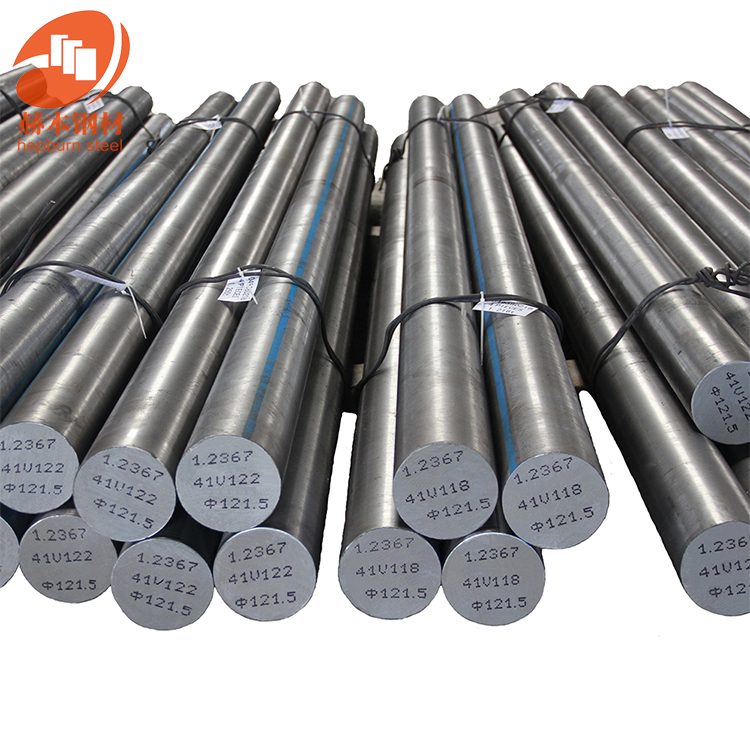
1.2367 | H13+Mo
1.2367 hot-work die steel features high toughness, high-temperature resistance, resistance to thermal cracking, resistance to thermal shock cracking, and resistance to thermal wear.
Available Form
Round Bar
Custom Diameter & Length
Flat Bar
Custom Thickness, Width & Length
Square Bar
Custom Width & Length
Steel Plate
Custom Thickness, Width & Length
Steel Grade Comparison(wt%)
| W-Nr | EN | AISI | JIS |
| 1.2367 | X38CrMoV5-3 | H13+Mo | – |
Chemical Composition
| C | Si | Mn | P | S | Cr | Mo | V |
| 0.35~0.40 | 0.30~0.50 | 0.30~0.60 | P≤0. 025 | 0. 015 | 4. 7~5. 2 | 2. 7~3. 3 | O. 40~0.70 |
Physical Properties
Density(g/cm3):7.83
Modulus of Elasticity(Gpa): 210
Thermal Conductivity(W/(m.k)): 25.0
| Temperature/℃ | 20-100 | 2-200 | 2-300 | 2-400 |
| Coefficient of Thermal Expansion(×10-6) | 11.5 | 12 | 12.2 | 12.5 |
Heat Treatment Process
Hardening: Heat the steel evenly to 1030~1060°C until the whole section reaches temperature. Then quench in oil to cool.
Annealing: Heat the steel to 820~840°C, hold it well at temperature, and then let it cool slowly inside the furnace.
Tempering: Heat the steel uniformly, hold it at the selected tempering temperature, and then allow it to cool in still air.
| Tempering Temperature℃ | 400 | 500 | 600 | 650 |
| Hardness (HRC) | 53 | 54 | 52 | 46.0 |
Application Fields
Wear resisting tools, pressure die casting tools, pressing tools for light and heavy metal. For the highest requirements we recommend UTOPMO7 ESR EFS.
Disclaimer: the information and data presented herein are typical values for reference and are not intended as warranties to readers.
REQUEST A QUOTE
Related Products