
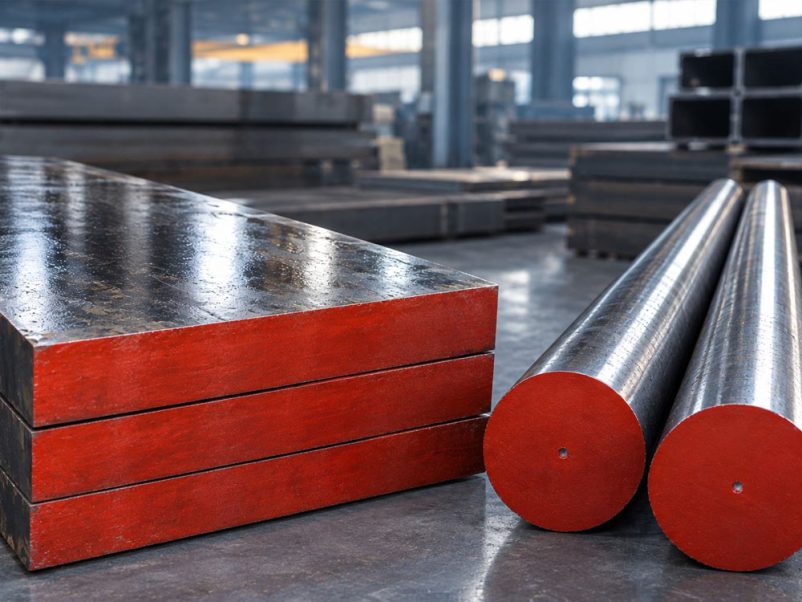
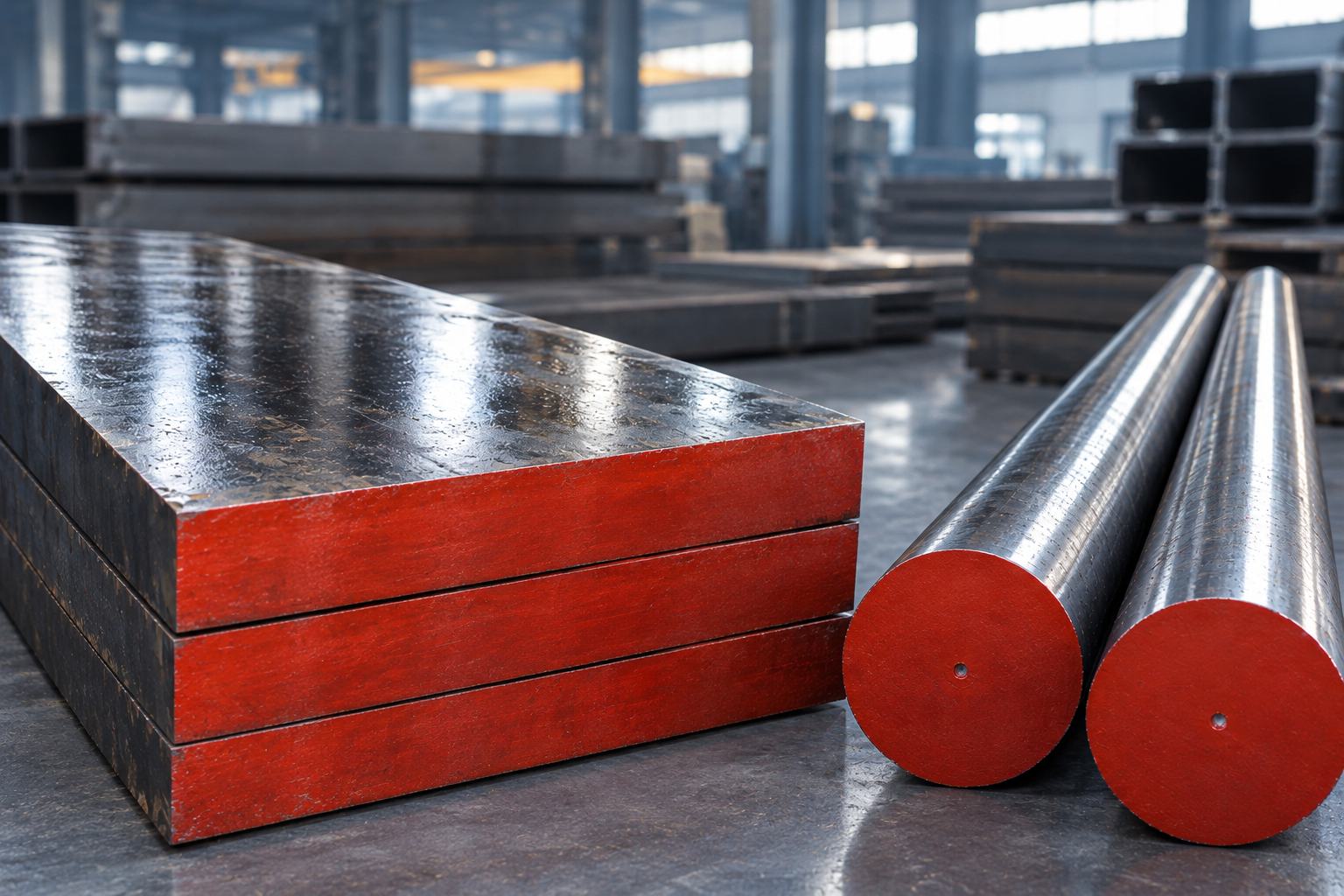
In mechanical and mold design, mold steels are generally divided into three main categories:
Cold Work Die Steel, Hot Work Die Steel, and Plastic Mold Steel.
When selecting mold steel, do not start with a familiar grade name. Instead, evaluate the actual working conditions:
How high are the wear requirements? Is edge chipping a concern? What is the operating temperature? Is mirror polishing required? Is the plastic material corrosive?
Six key properties deserve particular attention:
Hardness, wear resistance, toughness, hot strength, polishability, and corrosion resistance.
The following guide covers 12 commonly used mold steels, including their characteristics, typical hardness ranges, and applications.
1. Cold Work Die Steel: Balance Wear Resistance and Toughness
Cold work dies generally operate at room temperature and withstand extrusion, friction, shearing, and impact loads.
Typical applications include blanking, punching, cold forming, and precision stamping.
Common working hardness ranges from 58–62 HRC, although higher hardness does not always mean better performance.
1.1 Cr12MoV: A Common Choice for General Blanking Dies
Hardness: 58–62 HRC after heat treatment
Cr12MoV is a high-carbon, high-chromium cold work die steel offering good wear resistance and cost-effectiveness.
It is suitable for general blanking dies, punching dies, and wear-resistant components.
It is a practical option for cold work dies with moderate precision and service-life requirements.
1.2 SKD11: Widely Used in Precision Stamping
Hardness: 58–62 HRC after heat treatment
SKD11 is a highly wear-resistant cold work die steel. With appropriate heat treatment, it offers good wear resistance and dimensional stability.
Typical applications include precision stamping dies, forming dies, and mold components requiring high wear resistance.
Compared with Cr12MoV, material quality, heat-treatment distortion, and actual service requirements should be carefully evaluated during selection.
1.3 DC53: Designed for Improved Toughness and Resistance to Edge Chipping
Hardness: 60–62 HRC after heat treatment
DC53 is an improved cold work die steel that can combine high hardness with good toughness when properly heat-treated.
Compared with conventional SKD11, DC53 generally offers better resistance to edge chipping.
It is suitable for slender punches, fine blanking dies, and components where cracking or chipping is a concern.
Selection tip: If cutting edges repeatedly chip or crack, increasing hardness may not solve the problem. Toughness, die design, and heat-treatment conditions should also be investigated.
1.4 D2: High-Wear-Resistance Cold Work Die Steel
Hardness: 58–62 HRC after heat treatment
D2 is a high-carbon, high-chromium cold work die steel known for its excellent wear resistance.
It is suitable for blanking dies, forming dies, and other cold work applications requiring long wear life.
D2 and SKD11 belong to similar material families, but they should not automatically be considered identical. Applicable standards, chemical composition, and supply condition should be verified before purchasing or substituting materials.
2. Hot Work Die Steel: Focus on Hot Strength and Thermal Fatigue Resistance
Hot work dies operate repeatedly at elevated temperatures and withstand thermal shock, mechanical loads, and temperature fluctuations.
Typical applications include die casting, hot forging, and hot extrusion.
The working hardness of hot work die steel is generally lower than that of cold work die steel. Many applications use hardness levels around 44–50 HRC.
This is because hot work dies require not only wear resistance but also sufficient toughness and thermal fatigue resistance.
2.1 H13: A Versatile Hot Work Die Steel
Hardness: 44–50 HRC, a common range after heat treatment
H13 is a widely used chromium-molybdenum-vanadium hot work die steel.
It offers a good combination of hot strength, toughness, and thermal fatigue resistance. It is widely used for die-casting dies, hot forging dies, and hot extrusion dies.
For conventional hot work applications, H13 is a well-established and practical choice.
2.2 SKD61: A Common Choice for Repeated Thermal Cycling
Hardness: 44–50 HRC, a common range after heat treatment
SKD61 is a chromium-molybdenum-vanadium hot work die steel with good high-temperature strength and toughness.
It is commonly used for die-casting dies, hot punches, and other tooling exposed to repeated heating and cooling.
SKD61 and H13 belong to similar steel families but are specified under different standards. Their interchangeability should be confirmed against the relevant material specifications.
2.3 8407: For Demanding Die-Casting Applications
Hardness: 46–52 HRC, depending on service conditions and heat treatment
8407 is a premium chromium-molybdenum-vanadium hot work die steel grade.
It is valued for material cleanliness, microstructural uniformity, and thermal fatigue performance.
Typical applications include complex die cavities, high-volume die casting, and molds requiring improved resistance to heat checking and extended service life.
For standard die-casting applications, H13 or SKD61 may be sufficient. For more demanding operating conditions, premium hot work die steels such as 8407 can be evaluated.
2.4 FDAC: Prehardened Steel for Faster Machining and Delivery
Hardness: Approximately 38–42 HRC in the prehardened supply condition
FDAC is known for its prehardened delivery condition and good machinability.
For suitable applications, it can eliminate the need for subsequent bulk hardening, reducing production time and the risk of heat-treatment distortion.
It is commonly used for aluminum and zinc die-casting dies and molds with tight delivery schedules.
For severe impact loads or demanding thermal fatigue conditions, its toughness and actual service life should be carefully assessed rather than selecting it solely for machining convenience.
3. Plastic Mold Steel: Focus on Polishing, Corrosion Resistance, and Machining Stability
Plastic mold steel requires a different selection approach from cold and hot work die steel.
In addition to strength and wear resistance, important considerations include part appearance, polishing requirements, the corrosiveness of plastic compounds, and dimensional changes during subsequent heat treatment.
Prehardened steels often meet the needs of general plastic molds. High-gloss, mirror-finish, corrosion-resistant, or high-wear applications may require more specialized grades.
3.1 P20: General-Purpose Plastic Mold Steel
Hardness: 28–32 HRC in the prehardened supply condition
P20 is a widely used prehardened plastic mold steel offering relatively low cost and good machinability.
It is suitable for general plastic molds, medium-to-large mold cavities, and standard structural components.
For ordinary plastic products without demanding appearance requirements or significant corrosion risks, a high-cost mirror-polishing grade may not be necessary.
3.2 718 / 718H: Commonly Used for Appearance Parts
Hardness: Approximately 30–37 HRC in the prehardened supply condition, depending on the grade
The 718 family consists of modified prehardened plastic mold steels.
Compared with conventional P20, these grades generally place greater emphasis on hardness uniformity in large sections and polishing performance.
They are commonly used for automotive plastic parts, home appliance housings, and medium-to-large injection molds.
They are practical choices for molds requiring a certain level of surface appearance while minimizing the need for subsequent bulk heat treatment.
3.3 NAK80: A Popular Choice for High-Gloss and Mirror-Finish Molds
Hardness: Approximately 37–43 HRC in the prehardened supply condition
NAK80 is a well-known prehardened plastic mold steel for mirror-finish applications.
It offers good polishability and electrical discharge machining (EDM) performance, making it suitable for high-gloss appearance parts, precision plastic components, and mirror-finish molds.
Its prehardened supply condition can eliminate the need for subsequent bulk hardening, helping reduce production time and dimensional changes.
Selection tip: If high-gloss appearance and mirror finishing are the primary requirements, NAK80 is worth considering. If the application also involves significant corrosion risks, a corrosion-resistant mold steel may be more appropriate.
3.4 S136 / S136H: Combining Mirror Polishability with Corrosion Resistance
S136: Commonly 48–52 HRC after heat treatment
S136H: Typically around 30–35 HRC in the prehardened supply condition
The S136 family consists of corrosion-resistant plastic mold steels offering good polishability and corrosion resistance.
Typical applications include transparent plastic parts, medical product molds, molds for plastics containing corrosive additives, and applications requiring improved resistance to rust.
The main difference between S136 and S136H lies in their supply condition and subsequent heat-treatment requirements.
S136: Can achieve higher hardness through heat treatment and is suitable for molds requiring a combination of wear resistance, mirror polishability, and corrosion resistance.
S136H: Supplied in a prehardened condition and can be machined directly, making it suitable for applications where minimizing subsequent heat-treatment distortion is important.
The final selection should also consider mold life, required mirror-finish quality, and machining processes.
4. How to Select Mold Steel for Real-World Applications
Step 1: Identify the Type of Mold
Cold work dies prioritize wear resistance, toughness, and resistance to edge chipping.
Hot work dies prioritize hot strength and thermal fatigue resistance.
Plastic molds place greater emphasis on machinability, polishing quality, and corrosion resistance.
Step 2: Shortlist Grades Based on Operating Conditions
Cold work dies
General blanking: Cr12MoV.
Precision stamping: Evaluate SKD11 or D2.
Higher toughness requirements or recurring edge chipping: Consider DC53.
Hot work dies
Conventional die casting and hot forging: Evaluate H13 or SKD61.
Demanding die-casting applications: Consider 8407.
Prehardened machining and shorter production cycles: Evaluate FDAC.
Plastic molds
General plastic products: P20.
Medium-to-large molds for appearance parts: 718/718H.
High-gloss and mirror-finish molds: NAK80.
Corrosion-resistant and high-polish applications: S136/S136H.
Step 3: Confirm the Supply Condition and Heat-Treatment Requirements
Even within the same steel grade, the final hardness, dimensional stability, and service life may vary with the supplier, section size, material quality, and heat-treatment process.
Pay particular attention to the following grades:
P20, 718/718H, NAK80, S136H, and FDAC are commonly supplied in prehardened conditions, and their typical hardness values generally refer to that condition.
The hardness ranges given for the other listed cold work and hot work steels, as well as S136, generally refer to common working conditions after heat treatment.
Prehardened supply hardness must not be confused with the final working hardness obtained after quenching and tempering.
5. Final Thoughts
Mold steel selection should never be based simply on the assumption that a more expensive grade or a higher hardness will always deliver better results.
For cold work dies, prioritize wear resistance and toughness. For hot work dies, focus on hot strength and thermal fatigue resistance. For plastic molds, evaluate polishability, corrosion resistance, and machining stability.
Selecting the right material is only the first step. Heat treatment, mold design, surface finishing, and maintenance are equally important to overall performance and service life.
The hardness ranges in this guide are intended for preliminary selection rather than final acceptance. Actual design and purchasing decisions should be based on the material manufacturer’s technical data, applicable standards, and specified heat-treatment requirements.
Choosing the right steel for the actual working conditions is the foundation of mold life, dimensional accuracy, and manufacturing quality.