
1. Carbon (C)
Carbon plays a crucial role in balancing the strength and toughness of steel. Controlling carbon content is a key aspect of steel design and production.
As carbon content increases, steel generally becomes harder and stronger, but its ductility and toughness tend to decrease. When the carbon content exceeds approximately 0.23%, the weldability of steel deteriorates. Therefore, the carbon content of low-alloy structural steels intended for welding is generally limited to around 0.20% or less. Higher carbon content can also reduce atmospheric corrosion resistance, making high-carbon steel more susceptible to rusting when stored outdoors. In addition, carbon increases cold brittleness and strain-aging sensitivity.
1.1 Effects on the Microstructure of Steel
Carbon content determines the microstructure of steel, including the proportions of pearlite, bainite, and martensite formed under different processing and heat-treatment conditions. These microstructural characteristics directly affect the overall properties of steel.
1.2 Effects on Heat Treatment
Hardenability and hardness: Steel with higher carbon content can achieve greater hardness after heat treatment, particularly quenching, because carbon contributes to martensite formation. Carbon also influences phase-transformation temperatures and the final properties of heat-treated steel.
1.3 Effects on Mechanical Properties
Increases strength and hardness: Increasing carbon content generally improves the strength and hardness of steel. Carbon can form iron carbide (Fe₃C, cementite) and contribute to resistance against deformation.
Reduces ductility and toughness: Although carbon increases strength and hardness, excessive carbon content reduces ductility and toughness, making steel more susceptible to brittle fracture.
2. Silicon (Si)
Silicon is primarily used as a deoxidizing agent in steelmaking. It effectively removes dissolved oxygen from molten steel, helping improve steel cleanliness. In appropriate amounts, silicon increases strength, hardness, and the elastic limit of steel while improving wear resistance and oxidation resistance.
However, excessive silicon content can reduce ductility and toughness and may adversely affect machinability and weldability. Therefore, silicon content must be carefully controlled to achieve the desired balance of properties.
2.1 Effects on the Microstructure and Heat Treatment of Steel
As an alloying element, silicon is commonly present in steel as a solid solution in ferrite or austenite. In alloy steels, its content may be approximately 0.4% or higher, depending on the grade and intended application. Silicon generally contracts the austenite phase region.
Silicon raises the temperatures required for annealing, normalizing, and quenching under certain conditions. It also increases the hardenability of hypoeutectoid steels.
Silicon does not readily form carbides and strongly promotes graphitization. In medium- and high-carbon steels containing relatively high silicon levels, graphitization may occur under certain temperature conditions, particularly when strong carbide-forming elements are absent.
In carburizing steels, silicon can reduce the depth of the carburized case and lower the carbon concentration in the carburized layer.
Silicon is an effective deoxidizing agent in molten steel.
2.2 Effects on the Mechanical Properties of Steel
Silicon strengthens and hardens ferrite and austenite. Its strengthening effect can be greater than that of several other alloying elements, including manganese, nickel, chromium, tungsten, molybdenum, and vanadium, depending on the steel composition and microstructure.
Silicon significantly increases the elastic limit, yield strength, yield ratio, fatigue strength, and fatigue ratio of steel.
When silicon content exceeds approximately 3%, the ductility and toughness of many steels decrease significantly, although the extent depends on the steel grade and microstructure.
Silicon can promote banded microstructures, potentially causing transverse mechanical properties to be inferior to longitudinal properties.
Silicon can improve the wear resistance of steel.
2.3 Effects on the Physical, Chemical, and Processing Properties of Steel
Silicon reduces the density, thermal conductivity, electrical conductivity, and temperature coefficient of electrical resistance of steel.
Silicon steel sheets generally have lower eddy-current losses than pure iron. They can also exhibit lower coercivity and hysteresis losses, together with higher magnetic permeability and, under suitable conditions, improved magnetic performance. However, silicon can reduce magnetic flux density under strong magnetic fields, depending on composition and operating conditions.
Silicon improves the oxidation resistance of steel at elevated temperatures. However, higher silicon contents may aggravate surface decarburization under certain heating conditions.
Silicon generally reduces the weldability of steel, particularly at higher concentrations.
2.4 Applications of Silicon in Different Steel Grades
Ordinary low-alloy steels: Silicon increases strength and may improve corrosion resistance under certain conditions. In quenched-and-tempered steels, it can improve hardenability and resistance to tempering softening. It is an important alloying element in many multi-alloy structural steels.
Spring steels: Silicon-manganese (Si-Mn) and silicon-manganese-boron (Si-Mn-B) steels containing approximately 0.5%–2.8% silicon are widely used for highly loaded springs. Elements such as tungsten, vanadium, molybdenum, niobium, and chromium may also be added, depending on the grade.
Electrical silicon steel: Low-carbon and ultra-low-carbon silicon steels containing approximately 1.0%–4.5% silicon are used in electric motors and transformers because of their favorable magnetic properties.
Stainless and corrosion-resistant steels: Silicon can be combined with molybdenum, tungsten, chromium, aluminum, titanium, nitrogen, and other elements to improve corrosion resistance and high-temperature oxidation resistance.
Graphitic steels: High-silicon graphitic steels can be used in certain cold-work die applications.
3. Manganese (Mn)
Manganese increases the strength and hardness of steel while improving hardenability and, in suitable compositions and microstructures, wear resistance. It also serves as a deoxidizing and desulfurizing agent during steelmaking, helping improve hot-workability and the overall quality of steel.
However, excessive manganese content or inappropriate processing conditions may adversely affect ductility, weldability, and toughness. Manganese can also increase susceptibility to grain growth and temper embrittlement under certain conditions.
3.1 Effects on the Microstructure and Heat Treatment of Steel
Manganese is an effective deoxidizing and desulfurizing agent. Most commercial steels contain a certain amount of manganese.
Manganese dissolves in ferrite and austenite and expands the austenite phase region. It raises the A₄ transformation temperature and lowers the A₃ transformation temperature, shifting the ferrite-austenite phase boundaries. At manganese contents above approximately 12%, depending on the overall composition, the upper critical transformation temperature may fall below room temperature, allowing a predominantly austenitic microstructure to remain stable at room temperature.
Manganese lowers the eutectoid transformation temperature and reduces the carbon content at the eutectoid composition.
Manganese significantly lowers the Ar₁ transformation temperature and the martensite-start temperature (Mₛ), with its influence on Mₛ being less pronounced than that of carbon. It also slows phase transformations, increases hardenability, and can increase the retained-austenite content after quenching.
Manganese helps produce a more uniform and refined microstructure in quenched-and-tempered steel. It can also influence carbide distribution in carburized layers. However, manganese may increase sensitivity to overheating and the tendency toward temper embrittlement under certain conditions.
Manganese is considered a weak carbide-forming element.
3.2 Effects on the Mechanical Properties of Steel
Manganese strengthens ferrite and austenite, although its solid-solution strengthening effect is generally weaker than that of carbon, phosphorus, and silicon. Within suitable composition ranges, manganese can increase strength without significantly reducing ductility.
Manganese refines pearlite and significantly increases the strength of low- and medium-carbon pearlitic steels, although ductility may decrease to some extent.
By improving hardenability, manganese enhances the mechanical properties of quenched-and-tempered steels with a sorbitic microstructure.
When heat-treatment parameters are properly controlled and overheating, excessive grain growth, and temper embrittlement are avoided, manganese does not necessarily reduce the toughness of steel.
3.3 Effects on the Physical, Chemical, and Processing Properties of Steel
Increasing manganese content can significantly reduce thermal conductivity and increase the coefficient of linear thermal expansion. These changes may generate greater internal stresses during rapid heating or cooling, increasing the risk of cracking in certain components.
Manganese significantly reduces electrical conductivity and increases electrical resistivity. It also reduces the temperature coefficient of electrical resistance.
Manganese increases coercivity and reduces saturation magnetic flux density, remanent magnetic flux density, and magnetic permeability. Consequently, manganese may be beneficial in certain permanent-magnet alloys but detrimental to soft-magnetic alloys.
At high concentrations, manganese can reduce the oxidation resistance of steel.
Manganese combines with sulfur to form manganese sulfide (MnS), which has a higher melting point than iron sulfide (FeS). This helps prevent the formation of low-melting FeS films along grain boundaries, reduces hot shortness, and improves hot-working properties.
High-manganese austenitic steels can exhibit high deformation resistance and pronounced columnar crystallization in ingots, increasing the risk of cracking during forging and rolling if processing conditions are not properly controlled.
By increasing hardenability and lowering the martensite-start temperature, manganese can adversely affect weldability. Appropriate control of carbon content and welding procedures can help mitigate these effects.
During steelmaking, manganese acts as an effective deoxidizer and desulfurizer. Ordinary carbon steels typically contain approximately 0.30%–0.50% manganese, although actual levels vary by grade. Carbon steels containing more than approximately 0.70% manganese are sometimes referred to as manganese steels. Compared with steels containing lower manganese levels, these grades can offer a favorable combination of toughness, strength, and hardness, along with improved hardenability and hot-workability.
3.4 Applications of Manganese in Different Steel Grades
Free-machining steels: Appropriate amounts of manganese and sulfur are used in certain free-machining steels. MnS inclusions help promote chip breaking and improve machinability.
Ordinary low-alloy steels: Manganese strengthens ferrite and pearlite, increasing steel strength. Typical manganese contents are approximately 1%–2% in some grades, although the actual range varies.
Carburizing and quenched-and-tempered alloy structural steels: Many grades contain manganese at levels generally below 2%, depending on their composition and intended application.
Spring steels, bearing steels, and tool steels: Manganese improves hardenability, potentially allowing oil quenching or air cooling in selected grades and reducing the risk of cracking, distortion, and dimensional deformation when the heat-treatment process is properly designed.
Wear-resistant steels: High-manganese wear-resistant cast steels commonly contain approximately 10%–14% manganese.
Non-magnetic steels: Certain medium-carbon high-manganese non-magnetic steels contain approximately 18%–19% manganese.
Heat-resistant steels: Some high-manganese heat-resistant steels use manganese to replace part of the nickel content or combine manganese with aluminum, molybdenum, vanadium, and other alloying elements.
3.5 Additional Considerations When Using Manganese
Manganese is widely used as a deoxidizing agent in steelmaking. Many ordinary steels contain manganese at levels of up to approximately 0.7%, although the actual content depends on the grade.
Manganese counteracts the adverse effects of sulfur by forming MnS, helping reduce sulfur-related hot shortness.
Higher manganese contents may increase susceptibility to temper embrittlement, depending on the steel composition and heat-treatment conditions.
Manganese promotes grain growth under certain conditions, making manganese steels potentially sensitive to overheating during heat treatment. Grain-refining additions such as molybdenum, vanadium, and titanium may help mitigate this tendency when appropriately designed.
Manganese contents above approximately 1% may adversely affect weldability in some steels. However, the actual effect depends on the complete chemical composition, carbon equivalent, microstructure, and welding procedure.
Manganese does not universally reduce corrosion resistance; its effect depends on the steel grade, composition, and service environment.
Conclusion
Carbon, silicon, and manganese each play distinct roles in determining the properties of alloy steel.
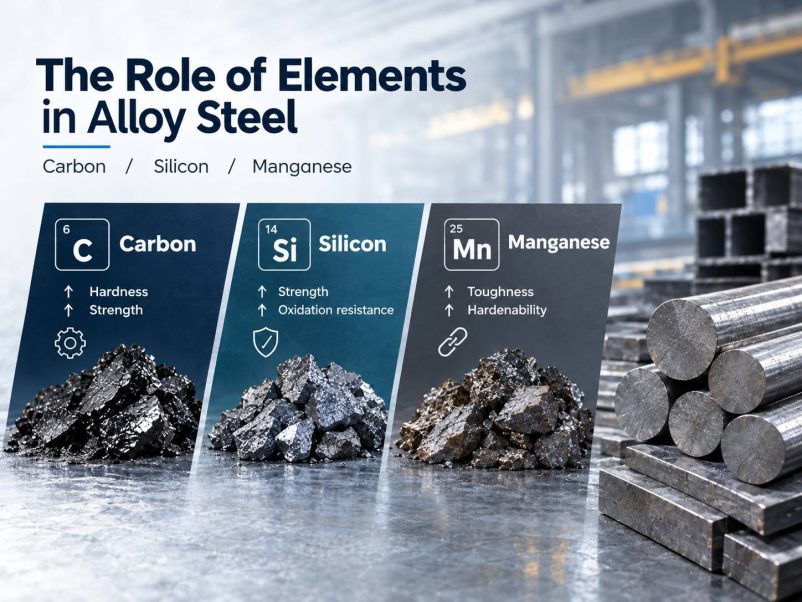
Carbon (C) primarily controls hardness, strength, hardening response, and the balance between strength and toughness.
Silicon (Si) acts as a deoxidizer and contributes to strength, elasticity, wear resistance, oxidation resistance, and magnetic performance in electrical steels.
Manganese (Mn) acts as a deoxidizer and desulfurizer while improving hardenability, strength, and the performance of many structural, spring, tool, and wear-resistant steels.
The final properties of steel depend not only on the content of each individual element but also on the interaction between alloying elements, the steelmaking process, the microstructure, and the heat-treatment conditions. Selecting the appropriate chemical composition is therefore essential to achieving the required mechanical properties and service performance.